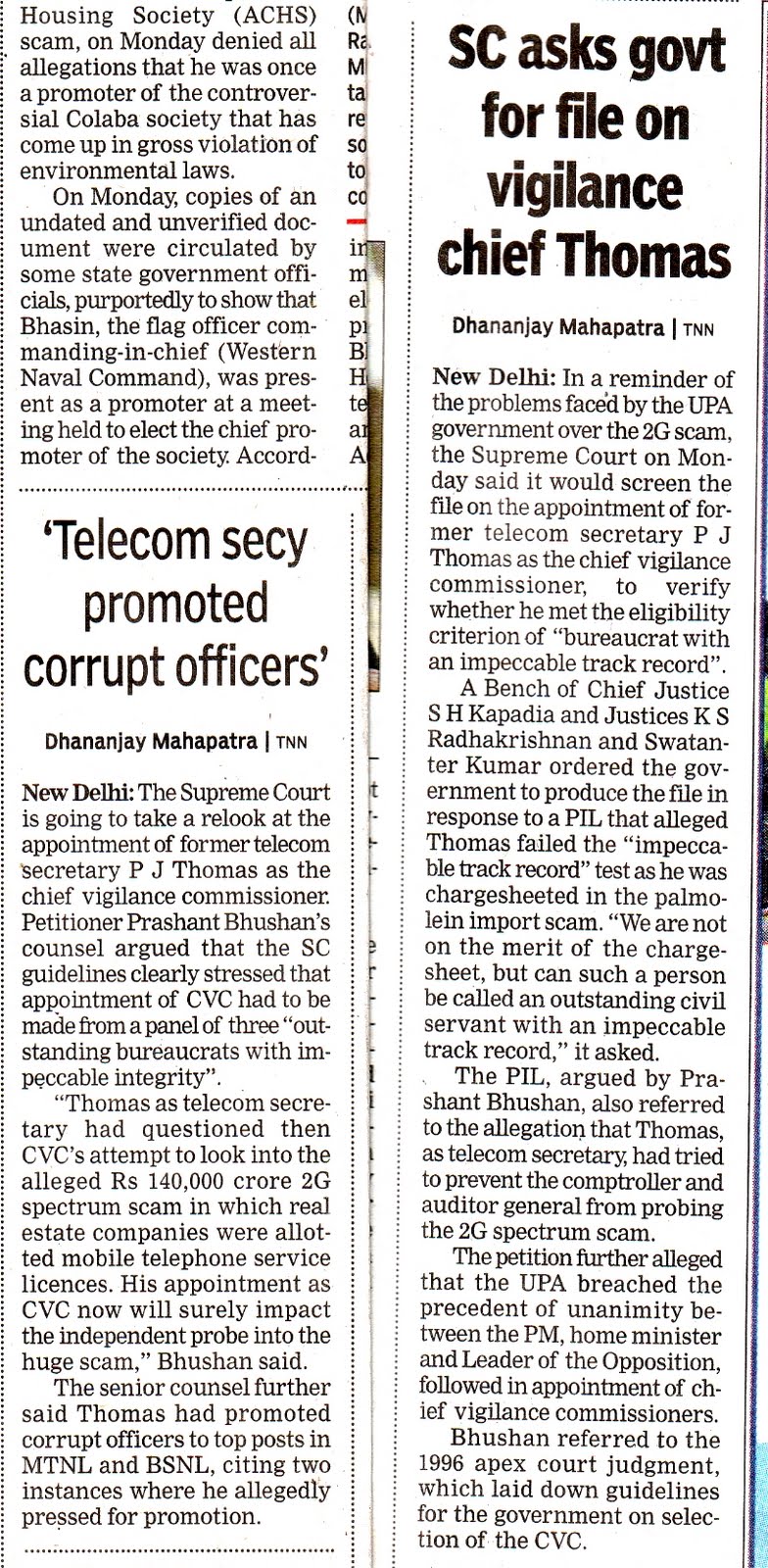
अब इस में कोई संदेह नहीं रहा कि यह सरकार भ्रष्टाचार और भ्रष्टाचारियों के खिलाफ कोई सख्त कदम नहीं उठाएगी. इस सरकार का हर कार्य नागरिकों के खिलाफ और भ्रष्टाचारियों के पक्ष में होता है. अब जहाँ भी जब भी चुनाव हो, मतदाताओं को इस भ्रष्ट सरकार और इसकी साथी भ्रष्ट पार्टियों को हराना है.

जन लोकपाल बिल को कानून बनाओ, फिर हमसे वोट मांगने आओ, नहीं तो हार के गहरे समुन्दर में डूबने के लिए तैयार हो जाओ.
Showing posts with label CVC. Show all posts

Friday, January 28, 2011

एक और स्केम - सर्वोच्च स्तर पर भ्रष्टाचार

सुप्रीम कोर्ट में सरकार का नया झूट
क्या आप सपने में भी यह सोच सकते हैं कि जब प्रधानमंत्री की अध्यक्षता में एक सर्वोच्च अधिकार प्राप्त समिति देश के केन्द्रीय सतर्कता आयुक्त का चयन करती है तब उम्मीदवारों के बारे में पूरी जानकारी समिति के सामने नहीं होती? नहीं सोच सकते न? मैं भी नहीं सोच सकता, पर ऐसा हुआ है. भारत सरकार ने सुप्रीम कोर्ट को बताया है कि केन्द्रीय सतर्कता आयुक्त पद के लिए चयन करते समय समिति के सामने एक उम्मीदवार पी जे थामस के खिलाफ भ्रष्टाचार के लिए चार्ज शीट और केरल सरकार द्वारा उन पर मुकदमा चलाये जाने की अनुमति के बारे में कोई जानकारी नहीं थी. विस्तृत वर्णन के लिए क्लिक करें.

यह सर्व विदित है कि इस ३ सदस्यीय समिति में प्रधानमंत्री के अलाबा गृह मंत्री और लोक सभा में विपक्ष के नेता होते हैं. विपक्ष की  नेता ने थामस के खिलाफ इस चार्ज के बारे में समिति को बताया था और उनको इस पद के लिए चुने जाने पर अपना विरोध दर्ज कराया था. लेकिन समिति ने २:१ से इस ऐतराज को रद्द करते हुए थामस को केन्द्रीय सतर्कता आयुक्त के पद के लिए चुन लिया. आज कल सुप्रीम कोर्ट में इस बारे में सुनवाई हो रही है.

एक बहुत छोटे पद के लिए भी सरकारी कर्मचारियों के बारे में सम्बंधित विभाग चयन समिति को पूरा विवरण देता है जिस में विजिलेंस सम्बन्धी जानकारी भी होती है. लेकिन यहाँ देश के केन्द्रीय सतर्कता आयुक्त पद के लिए चयन हुआ, चयन समिति के अध्यक्ष स्वयं प्रधान मंत्री थे, गृह मंत्री और विपक्ष के नेता समिति के सदस्य थे, पर सरकार के अनुसार यह जानकारी सम्बंधित विभाग द्वारा समिति को नहीं दी गई. मजे की बात यह है कि इस सम्बंधित विभाग के मंत्री प्रधानमंत्री स्वयं हैं. अब यह तो अपने आप में खुद एक स्केम हो गया.

अब बताइए इस देश में भ्रष्टाचार कैसे कम होगा?

Tuesday, January 18, 2011

Govt survives on corruption and corrupt

The question which SC asked the Govt is a question which every Indian citizen is asking - "How P J Thomas will function as CVC - Whenever he will entertain a complaint and order inquiry, he will face the question - 'you yourself are an accused, how can you look in to another complaint'."The Govt has not answered this question but is harping on its prerogative as an appointing authority.

The Govt says that unanimity in a democratic selection process does not always work. OK, it is accepted, but how the majority view is achieved? The panel has three members, PM, Home Minister and Leader of Opposition. PM and HM belong to the Govt. They will always have the same view. If LoP is having a different view then it will have no effect. In this case it has haapened. PM and HM wanted Thomas so he was appointed as CVC. LoP pointed out towards the fact that Thomas is a tainted person as he was accused of criminal conspiracy in the palmolein oil import scam. What effect it had on the choice of Thomas as CVC? What is the use of having such a panel? Whom the Govt is making fool of? If the panel had equal number of members fron Govt and opposition then it was not possible for a tainted Thomas to become CVC.

Another point, the Govt had asked Thomas to resign. Why did it do so, if what it says in the affidavit is correct - "The PM and the home minister found Thomas as the most suitable candidate to hold the post of CVC".


The cat is out of the bag. Govt attitude in case of every scam is clear. It wants to protect the corruption and the corrupt. Its survival is dependent on the survival of corruption and the corrupt. They are the family.

Sunday, December 12, 2010

Citizens have lost all faith in CVC

December 9 was celeberated as International Anti-corruption Day. Tainted CVC P J Thomas launched a portal called 'Vig-Eye' where citizens can upload videos or audio clips exposing corrupt acts in Govt departments. Facility of on-line registration of compalints is already available on CVC website. Citizens can send complaints by other means also.

The need of the citizens is that appropriate action should be taken on complaints lodged by them. My experience with CVC is highly unsatisfactory. I lodged a complaint with CVC against CD ROM Scam in Bureau of Indian Standards (BIS), India's National Standards Body, working under Ministry of Consumer Affairs. CVC registered the complaint and forwarded it to CVO in BIS on 27.01.2010 to investigate and send report to CVC in three months. Today it 12.12.2010 (more than 10 months) but CVO BIS has not sent the investigation report to CVC. I have sent number of reminders but CVC does seem to have lost all interest in this scam where BIS has been put to a loss of Rs 5 Crores and a daily recurring loss of Rs. 65,000. All officers involved in the scam have been promoted and are enjoying the best of life.

What is the use of 21st century technology if no action is taken on the complaints lodged by the citizens? CVC and CVOs appointed by CVC are not working to remove corruption but are providing protection to corruption. Citizens have lost all faith in CVC.

Tuesday, November 23, 2010

CVC accused in a criminal case

A bench headed by Chief Justice SH Kapadia observed today that."without looking into the file, we are concerned that if a person is an accused in a criminal case how will he function as CVC." Bench made this observation after attorney general GE Vahanvati placed records of documents pertaining to Thomas appointment in a sealed cover. The name of Thomas figures in a charge sheet filed in a palmoleine export case.

The Congress Govt makes high claims on zero tolerance on corruption and yet it appoints, ignoring objections of Leader of Opposition, Thomas as CVC. Any person having any direct or indirect taint should not be appointed on constitutional posts. It sends wrong signals. The Govt has compromised the credibility of the institution of CVC. CBI has already lost the confidence of the people. How the people of India will be expected to believe that the Govt is sincere on the issue of corruption when it says something but does something opposite to that.

Source

Wednesday, November 10, 2010

Govt protects corruption to survive

Does Govt really want to eradicate corruption? Is Congress honest in saying that it has zero tolerance on corruption? Answer to these questions is a big NO.

Recent appointment of P J Thomas as CVC has once again confirmed that Congress has double standards on corruption. Congress talks of zero tolerance on corruption but in reality it protects corruption. Supreme Court is now examining whether new CVC can be called an outstanding civil servant with an impeccable track record.

Any Govt which compromises for its survival can not be called an honest Govt; and a Govt which is not honest can not be act against corruption. It could only find P J Thomas as new CVC, who as Telecom Sec had questioned the old CVC's attempt to look in to the alleged Rs. 140,000 crore 2 G spectrum scam. It is also alleged that P J Thomas had promoted corrupt officers to top posts in MTNL and BSNL.

How can India fight against corruption with congress in power and Thomas as CVC?

Tuesday, November 02, 2010

How to root out corruption

Arvind Kejriwal has wrtitten an article in Times of India, titled "How to root out corruption". He has rightly pointed out that the present anti-corruption laws and systems in our country suffer from internal contradictions. There is a plethora of anti-corruption agencies. In each of these agencies, the government has deliberately left some critical loophole so as to make it ineffective.

He suggests that all these anti-corruption agencies should be merged into one single agency, the Lokpal. Give it jurisdiction over both bureaucrats and politicians. Give it comprehensive powers to investigate and prosecute the guilty without needing any permission.

Friday, October 22, 2010

Story of a corrupt Chief Viglance Officer (CVO)

Central Vigilance Commission (CVC) appoints CVO in various government offices. Think what will happen if this CVO himself is corrupt. Here is the story of a CVO officer:

"Running a fake institute from within the IIT Kharagpur Campus is not the only way in which Amit Kumar Ghosh of the aerospace department made his name. From 2006 to 2008, Ghosh was chairman of Joint Entrance Examination, Kharagpur, when the maximum number of bunglings took place. Documents with TOI show that he not only gave false statements but on his charge, material related to JEE was destroyed despite clear rules that it be retained for a year.
Ironically, he was chief vigiliance officer of IIT, Kharagpur till recently.
On August 24, 2006, much after students had taken admission in IITs, as individual marks of candidates were released, it was found that students scoring just 154 marks were declared qualified though students with 279 marks were disqualified.
If this was not enough, Ghosh's response to a student who had not qualified despite scoring 231 marks (104 in physics, 75 in maths and 52 in chemistry) was that "he has not satisfied the marks eligibility criteria laid down for individual subjects as well as the aggregate marks in JEE 2006".
It was revealed in May 2007 that cutoffs for maths, physics, chemistry and aggregate were 37, 48, 55 and 154 respectively for general category students in JEE 2006, and the candidate in question scored much higher marks. But the procedure for cutoff calculation revealed by IITs showed that for maths, physics and chemistry, it should have been 7, 4 and 6 respectively instead of official figure of 37, 48 and 55.
Four different cutoff procedures submitted by IITs could not come to the stated official cutoffs. It also came to light that 994 candidates were deprived of admission due to discrepancy in calculation of cutoffs.
Even as pressure was mounting on IIT directors, chairpersons of board of governors and council members about irregularities, Ghosh sought an approval on October 31, 2006 for shredding of JEE specific material, including ORS scripts. The IIT statute clearly states that JEE papers will not be destroyed for a year."


(Source - TOI)

Monday, October 11, 2010

भ्रष्टाचार - हम सिर्फ बातें करें, इसे दूर कोई और करे

सुप्रीम कोर्ट ने बहुत चिंता जताते हुए कहा कि सरकारी महकमों में बिना पैसा दिए कुछ नहीं होता. मोइली मंत्री ने कहा कि न्यायिक जबाबदेही बिल बस आने वाला है. रिटायर्ड मुख्य विजिलेंस कमिश्नर, सिन्हा ने कहा कि हर तीसरा इंडियन भ्रष्ट है. बाबू और राजनीतिबाज को भ्रष्टाचार से अलग कर के देखना तो क्या सोचना भी संभव नहीं है. किसी मंत्री का भ्रष्टाचार जब ख़बरों का विषय बन जाता है तब प्रधानमंत्री उसे क्लीन चिट दे देते हैं. काला धन खेलों में रिकार्ड भ्रष्टाचार पर 'देश की शान पर बट्टा न आये' का पर्दा डाल दिया केंद्र और दिल्ली सरकार ने.

भ्रष्टाचार है, भ्रष्टाचार है, ऐसा कहने वाले आप को बहुत मिल जायेंगे. एक तरह का फैशन हो गया है यह सब कहना. पर इस भ्रष्टाचार को दूर कौन करेगा? क्या कहने भर से यह भ्रष्टाचार दूर हो जाएगा? प्रधानमंत्री को क्या नजर नहीं आता कि उनके कई मंत्री भ्रष्टाचार में लिप्त हैं पर वह उन पर कार्यवाही करने की जगह उन्हें क्लीन चिट देते हैं. सेन्ट्रल बेंक आफ इंडिया का एक अधिकारी बेंक के चैयरमेन एवं मेनेजिंग डाइरेक्टर पर भ्रष्टाचार का आरोप लगाता है, वित्त मंत्रालय कई आरोप सही हैं इसकी पुष्टि भी करता है, पर केन्द्रीय सतर्कता आयोग उसकी शिकायत बंद कर देता है. बेंक कांग्रेस के एक प्रवक्ता को मुकदमा लड़ने के लिए लाखों रुपया देता है. सब मजे करते हैं, बस अधिकारी को प्रताड़ित किया जाता है.

इक्का-दुक्का भ्रष्टाचार करने वाले धर लिए जाते हैं, उन्हें सजा भी मिल जाती है, पर संगठित भ्रष्टाचार और भ्रष्टाचारियों के खिलाफ कुछ नहीं होता. सारी व्यवस्था ऐसे संगठित भ्रष्टाचारियों को सुरक्षा प्रदान करती है. शिकायत करने वाले (सीटी बजाने वाले) बेचारे अपनी नागरिक जिम्मेदारी निभाने के चक्कर में मारे जाते हैं. कितने ऐसे शिकायत कर्ताओं को मार दिया गया पर किसी अपराधी को सजा नहीं मिली.

सुप्रीम कोर्ट पहले कहता है कि सरकारों महकमों में भ्रष्टाचार है पर आगे कहता है कि बेचारे गरीब सरकारी अफसरों को भी कैसे ब्लेम किया जाय इस बढती महंगाई में? यह कैसी जिम्मेदारी निभाई सुप्रीम कोर्ट ने? छटे वेतन आयोग के बाद पगार दुगनी-तिगनी बढ़ गई है पर सुप्रीम कोर्ट के अनुसार महंगाई बाबुओं को भ्रष्ट बना रही है. सुप्रीम कोर्ट ने भी आखिरकार क्लीन चिट ही दे दी बाबुओं को. एक गाना आया है - सखी सैयां तो खूबही कमात है, महंगाई डायन खाए जात है.

Sunday, October 10, 2010

Fight against organized corruption

This is the story of a whistleblower, Abhijit Ghosh, who has retired as General Manager of Central Bank of India. He blew the whistle on H A Daruwalla, then Chairperson and Managing Director of the bank. In the eyes of the bank, Central Vigilance Commission (CVC), Government, he has committed a crime of exposing the organized corruption in the bank. He was harassed and victimized.

He had filed a comprehensive complaint before CVC against corruption of Daruwalla. CVC closed his complaint. CVC was wrong. It proved to be a part of the organized corruption chain. In August 2010, Ministry of Finance had informed the CVC that some of the allegations against daruwalla stand proved. But Daruwalla gets a clean chit and Ghosh is victimized.

Bank had paid Rs. 69.24 lakhs to lawyers to prove a corrupt Daruwalla clean. Out of this Rs. 48.5 lakhs was paid to Congress spokesman, Abhishek Manu Singhvi. Is this not RISHWAT? This is the charactersitic of organized corruption, involve as many influential people in the corruption so that to help themselves they help the corrupt.

CVC which is supposed to be the watchdog against corruption is a part of the organized corruption chain. When Paratyush Sinha CVC retired, he gave a statement that every third Indian is corrupt. On this a minister commented that some bureaucrats become saint after retirement. CLICK TO READ.

Thursday, September 23, 2010

Role of CVO in fighting corruption

In the entire chain of registering, investigating and decision making in corruption complaints, Chief Vigilance Officer (CVO) is the most important link after Disciplinary Authority, but it is also the weakest link. Officers in various government organizations exploit the tool of ‘deputation’ to avoid out-of-station transfers and secure appointments in those organizations where CVC-sponsored CVOs are appointed.

It is very difficult to believe that a person who has manipulated his own appointment as CVO will be an honest investigator in corruption cases. Manipulation in India does not come free. It needs both money and contacts at the right places. A CVO once commented that this is a life-time chance in his service life, and he will be a fool if he does not take advantage of it. He said that he has to recover the money he has spent on securing this appointment. I told him that I am totally against these outsider CVOs as they will be putting their own interest over the interest of the organization. Seeing the performance of successive CVOs in India's National Standards Body, Bureau of Indian Standards (BIS), I have been proved right.

It is required to provide solutions to the problems, but problems should not be created in the name of providing solutions. Successive CVOs in BIS have created vigilance problems to prove that they are needed and then to assert their authority. If today, BIS is mired in neck-deep corruption then it is because of these outsider CVOs. I remember writing in one issue of Contact (BIS Officers Association Journal) that a Police Station has been opened in BIS.

The case of Ms Harjot Kaur, IAS CVO in BIS is fresh in mind. She openly threatened (in presence of DG) members of BIS Employees Union. She organized illegal raids on some Mumbai licensees to teach lesson to a WRO officer. Complaints were lodged against her. What action has been taken on these complaints has not been informed to the complainants (BISEU and me). She suddenly went on long leave and had not returned till date.

In my comments sent to CVC on draft NACS, I have emphasized on this point. I have commented that CVC should put its own house in order and make CVOs accountable, so that they do not become a link in organized corruption chain in the organization. They should effectively and efficiently fight against corruption as third party and should not themselves become part of the corruption.

In case of Vinod Dhamija, another CVO in BIS, he was even made head of some departments of BIS. He created his own interest group in BIS and took all advantages. CVOs in BIS have manipulated number of cadre officers to be appointed in vigilance department in HQ and also in some RO/BO. It has depleted the strength of cadre and made these officers ineligible for promotions under FCS. Then CVO and DG violated provisions of FCS to get them promoted. My complaints are there but no action has been taken so far on these violations. All this puts a serious doubt on the honesty and integrity of DA, CVO and the officers who have worked in, or working in vigilance activity or have been illegally promoted.

To achieve the target of zero percent corruption in BIS, the pre-requisite is that BIS has honest, impartial and committed CVO and other officers in vigilance department. The purpose should not be to punish people but to achieve zero corruption in BIS. The initiative should come from the top. Regular and effective monitoring and review is needed in all work areas of the organization. Feedback from any source should be welcome and action be initiated. Who gives the feedback is not important, but to act on it is important.

Let CVOs prove their credentials.

Wednesday, September 22, 2010

Role of Citizens in fighting Corruption

Draft National Anti-corruption Strategy (NACS) is based on citizens’ active participation. It states that success in the battle against corruption hinges upon citizen participation in ushering in transparency and accountability. Citizens have a tremendous potential to participate directly and contribute at bringing about change using tools, such as:
a) moral appeals,
b)
exposure and embarrassment,
c)
appeals to pride,
d)
standing up and playing a key role in exposing wrong doing and non compliances.

All citizens of India should consider themselves under obligation to immediately report all corrupt practices being perpetrated, to actively take part in preventative measures against corruption, and raising awareness on corruption. To discharge this obligation they can use websites, blogs and by use RTI Act to get information about corruption and pass on to concerned authorities.

I know that, in amny organizations, above four tools are not proved very effective. Organized corruption in these organizations has become so deep rooted that people involved in corruption are not much bothered by moral appeals, exposure, embarassment and appeals to pride. Exposing wrong doing and non compliances also do not made much effect as corruption is being shielded by top management and investigating-prosecuting agencies.

It is a continued war against organized corruption. The day a small dent is made in the shield, the entire organized corruption apparatus will come down tumbling. In some organizations, small cracks have been made which, with time, will become more and more visible, and then the war will be won. Let us keep fighting corruption. That day will sure come.

Monday, September 20, 2010

Comments on National Anti-Corruption Strategy

I have submitted following comments on Draft National Anti-Corruption Strategy:

"NACS has distinguished corruption between petty and grand corruption. I believe that we should not use such terms for corruption. Corruption is corruption. Moreover using the term ‘grand’ for corruption gives respectability to corruption and glorifies corruption. I am sure that is not the intention of NACS.

It will be better to define corruption based on the methodology, as ‘unorganized corruption’ and ‘organized corruption’. Unorganized corruption will include petty corruption. Political and administrative corruption will come under organized corruption. Whereas people involved in unorganized corruption are exposed, caught and punished, the people involved in organized corruption may be exposed, may also be caught but hardly punished. The corruption loop in unorganized corruption is very short mostly revolving around the accused person, but in organized corruption the corruption loop is very large and includes the top and even the investigating and prosecuting persons or agencies.

Presently, the will is lacking to attack organized corruption. Under public and media pressure, organized corruption is sometimes investigated but every attempt is made to dilute it or give the accused persons a clean chit. I have taken up the ‘issue of attacking organized corruption’ with successive CVCs but did not get any response.

To quote from draft NACS – “Acceptance of bribe by the top management makes the subordinates follow the leader”. This in reality is happening in majority of organizations. Top management in such organizations provides total protection to corrupt subordinates, and CVOs posted in that organization also form a link in organized corruption chain (OCC).

The two main causes of administrative corruption as identified by draft NACS are: (a) inability of the civil servants to resist extraneous influences; and (b) active collusion. The active collusion of top with CVO also ensures the protection of CVC, which intentionally or un-intentionally becomes a link in OCC.

A citizen (includes a whistleblower) sends complaints about corruption to CVO but the complaints are not acknowledged and registered if these are against a person or persons belonging to OCC. Frustrated citizen complains to CVC. CVC after a long time sends a stock reply – “Your complaint has been duly examined in the commission and having regard to the nature of issues raised therein, the same has been forwarded to (Name) CVO of (Name) the organization for necessary action. As such, while no further report is required to be sent to the commission, the authorities concerned are required to look into and take such action as deemed fit.”

CVC sends back the complaint to the same CVO who had not taken any action earlier. Why would he take action now when he is not even asked to inform CVC about the action he has taken on the complaint? The result – nothing happens to the accused person(s) being the part of OCC, but the person who had made the complaint is made to suffer.

This is essential that CVC should put its own house in order and make its CVOs accountable. CVO is the most important link in fighting corruption, but it is also the weakest link. Most of the CVOs come on deputation to avoid out-of-station transfer. This they manage through any means. They willingly join the OCC and become an important link in shielding person(s) belonging to OCC.

My comments are based on my personal experience over a long period of time. NACS should incorporate a strategy for fighting Organized Corruption at an appropriate place."

National Anti-Corruption Strategy

Central Vigilance Commission (CVC) has posted a draft document on its website inviting comments on National Anti-Corruption Strategy. Last date of submitting comments is 20 September 2010. CLICK to read the draft and summary.

As per Preface – “The National Anti-Corruption Strategy represents a blue print for commitment and action by the various stakeholders to the governance process. It aims at systematic and conscious reshaping of the country’s national integrity system. The strategy recommends a set of action to be taken by the government and a set of action by the political entities, judiciary, media, citizens, private sector and civil society organizations. To ensure that the strategy does not remain a mere document, it is envisaged to ensure its effective implementation by developing suitable parameters for evaluating and monitoring the progress of its implementation. The CVC would review the progress on an annual basis and submit a report to the Parliament.”

Chapter VIII deals with the role of citizens in anti-corruption. Success in the battle against corruption hinges upon citizen participation in ushering in transparency and accountability. Citizens have a tremendous potential to participate directly and contribute at bringing about change using tools such as moral appeals, exposure and embarrassment, appeals to pride, standing and responsibility besides standing up and playing a key role in exposing wrong doing and non compliances.

As a citizen (grahak of services) and as a stakeholder to the governance process, I agree with this strategy. I am studying the document and will submit my comments. I will also post my comments on this blog.

My request is to all citizens to read and comment on this document, as the strategy and its effective and efficient implementation will ultimately help them.

सीवीसी, भ्रष्टाचार और नागरिक

फोटो पर क्लिक करें और यह खबर पढ़ें. सरकार के एक मंत्री का कहना है कि जो सरकारी बाबू अपने कार्यकाल में प्रभावशाली भूमिका निभा सकते थे पर निभा नहीं निभा पाए वह सेवा-निवृत्त होने के बाद संत हो जाते हैं. मंत्रीजी ने नाम तो नहीं लिया पर लगता है कि उनका ईशारा अभी-अभी सेवा-निवृत्त हुए केन्द्रीय सतर्कता आयुक्त श्री प्रत्यूष सिन्हा की तरफ है. इन सरकारी बाबू ने सेवा-निवृत्त होने के बाद शायद यह कहा कि एक तिहाई भारतीय जबदस्त भ्रष्टाचारी हैं, और आधे भारतीय भ्रष्टाचार की लक्ष्मण रेखा पार कर चुके या करने वाले हैं.